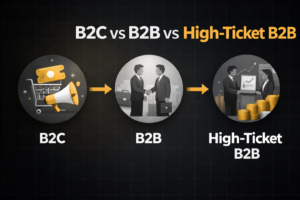
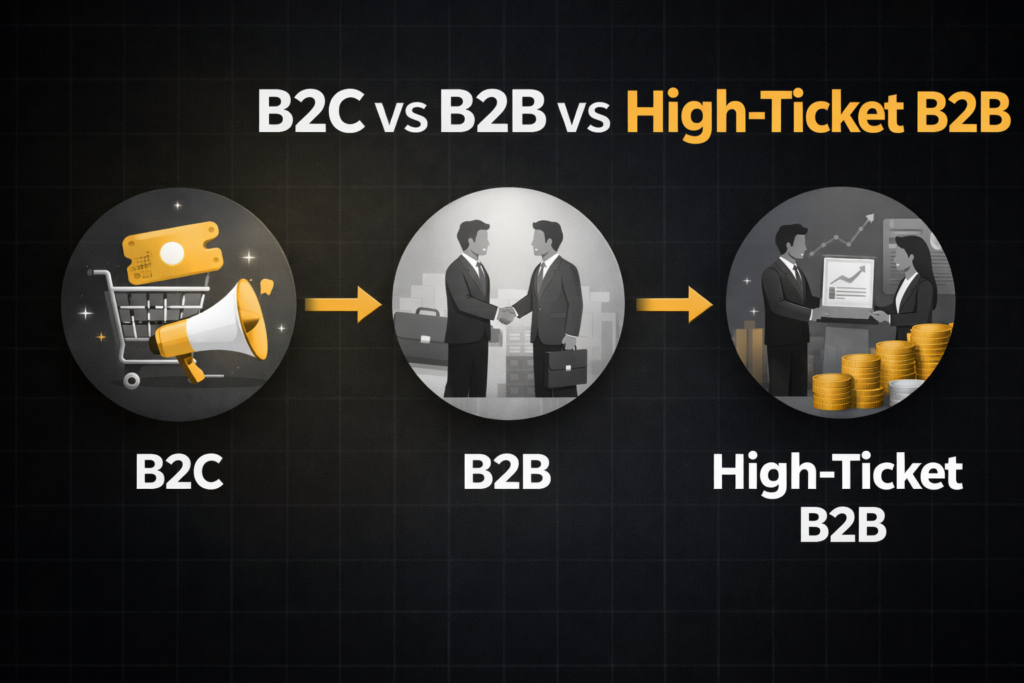
Not all sales and marketing work the same way, even if the goal always looks similar from the outside, attract attention, create trust, and close the deal. The difference is that in B2C, B2B, and high ticket B2B, the buyer’s mindset, decision process, and expectations are completely different. When businesses fail to understand this, they often use the wrong message, the wrong funnel, and the wrong sales approach.
In B2C, the process is usually faster, more emotional, and more volume driven. The buyer is often an individual making a personal decision, sometimes quickly and with limited comparison. Marketing in B2C is heavily focused on attention, desire, convenience, and immediate action. In standard B2B, the process becomes more rational and layered. The buyer is no longer just one person, and the purchase usually needs business justification, internal discussion, and a clearer return on investment. Here, trust, clarity, and relevance become more important than speed alone.
High ticket B2B is a different level altogether. The stakes are higher, the risk feels bigger, and the decision usually involves serious financial commitment, multiple stakeholders, and a deeper evaluation process. In this space, both sales and marketing need much more precision. You are not simply generating leads, you are guiding qualified decision makers through a trust based process. The messaging must be sharper, the targeting must be tighter, and the sales conversation must show business understanding, not just persuasion.
This is why high ticket B2B businesses, especially in areas like SaaS, fintech, consulting, or complex services, cannot rely on general marketing logic. What works in B2C may bring attention but not serious buyers, and what works in regular B2B may still be too broad for high value deals. The higher the ticket, the more important it becomes to focus on fit, authority, trust, and strategic communication. That is where real growth starts to become more intentional and more profitable.